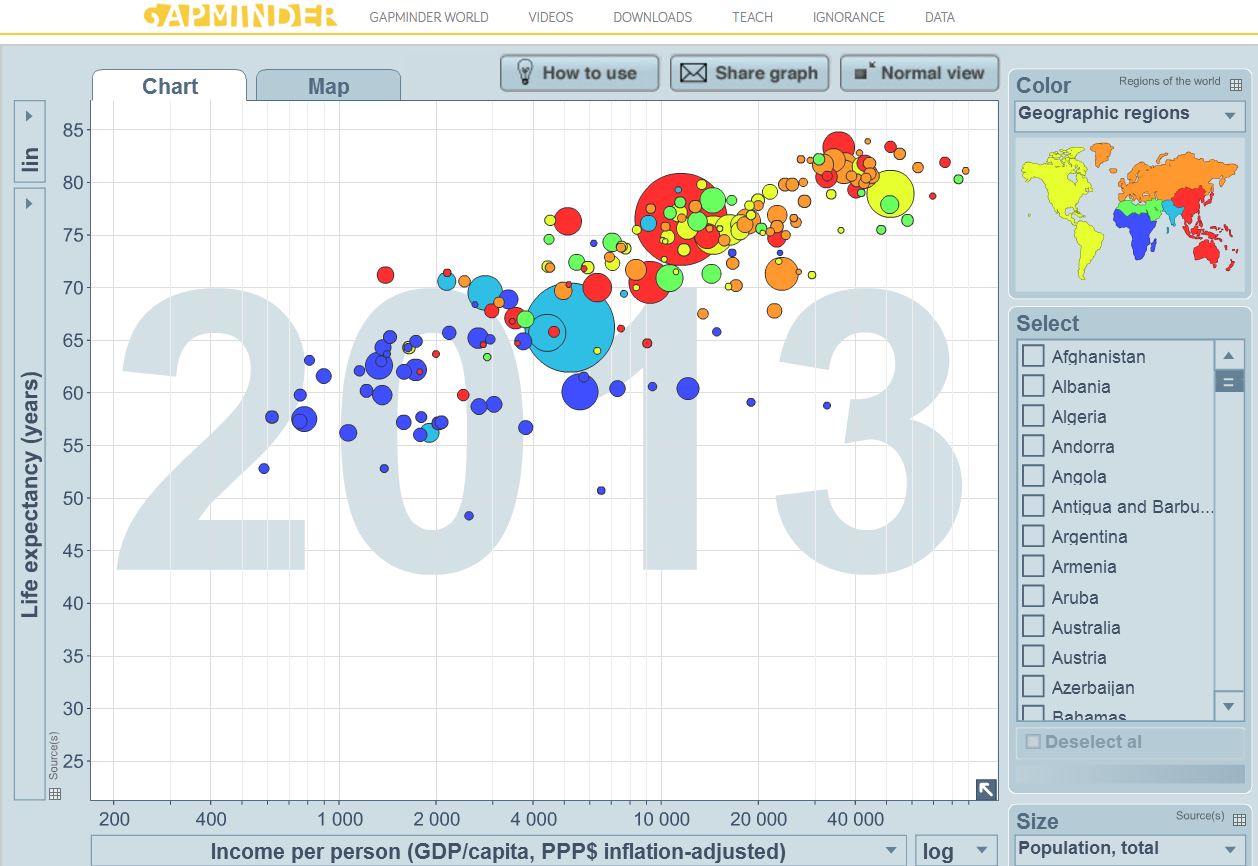
The increasing rate of urbanization has been accompanied by a corresponding rise in number of urban studies (Wang, et al., 2011). With most of the world’s population now living in urbanized regions, it becomes fair to ask how does living in cities affect society? Are there differences now that did not exist in previous social arrangements when urban life was the exception and not the norm? Along these lines, I wanted to look at a more fundamental assumption about urbanization – that urbanization drives economic growth, leading to better income levels and standards of living. My first question is simply, does urbanization drive economic growth and improve income levels and standards of living? Alternatively, the question could be asked if urbanization truly drives economic development leading to better living standards or are the roles reversed – does economic development precede urbanization? I will be using the urbanization variables from the Gapminder data set for my code book (e.g. income and urban population).
Additionally, if the data proves that urbanization is indeed the driver for better living conditions globally, the next step would be to examine if there is a threshold to that effect. How much effect does a country’s level of urbanization have on its economy (such as income levels and employment) and standard of living (such as inequality, mortality rate, and urban poverty)? Is there a globally uniform degree of urbanization after which gains are marginal? Does it hold true globally or are there countries that are exceptions? Does urbanization affect different populations of people differently? To investigate these secondary questions, I would need to add in variables such as employment rate and economic structure (based on percentage of different industries) and look at the relationships between the original variables differently.
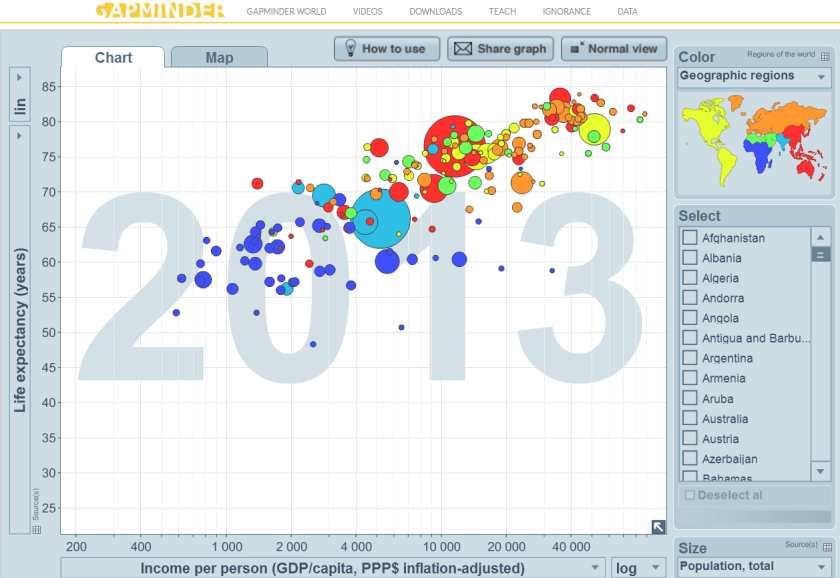
Gapminder Website’s Graph
Literature Review:
The rate of urbanization has been accelerating in the last few decades, driving greater and greater portions of the global population into developed areas. In many ways, city building, or more specifically the development of land, has become an economic force at an unprecedented level. The built environment has been identified as part of the process of capital flows, not only as a repository of wealth but also as a generator of it. Broadly speaking, scholars such as David Harvey (1978), Neil Smith (2008), and Andy Merrifield (2014) theorized that investments in the built environment create physical landscape for production, circulation, exchange, and consumption. Others such as John Friedmann (1986) and Saskia Sassen (1991) looked to cities as centers of economic control and examined a hierarchy of cities through data such as corporate headquarter locations.
Though not specifically focused on urbanization, Thomas Piketty’s (2014) latest book, Capitalism in the Twenty-First Century, looked at longitudinal income distribution and accumulation of capital through analysis of income tax return data from the World’s Top Income Database and national accounts. Grounded in historical data, his research suggests that wealth is accumulated especially through real estate in the period prior to World War II. Post-World War II, where much of the landed assets of the Western Hemisphere were destroyed, there was a redistribution of wealth. However, as the economy reinvests and redevelops landed assets, capital is starting to accumulate once again, especially in cities where the majority of the world now resides. As such, these scholars implicated the centrality of urbanization, especially in land development and the physical built environment, to economic growth and wealth accumulation.
From a more human-center perspective, urban studies have also looked at cities as centers of human capital that generate economic growth. By drawing larger populations of talent together, cities allow for higher levels productivity. For example, Carlino, Chatterjee, and Hunt (2007) related urban employment density with the rate of invention as defined by the number of patents per capita and demonstrated a positive correlation between the two variables. Others such as Abel, Day, and Gabe (2012) utilized urban GDP, population density, and human capital density based on education to demonstrate a positive relationship between productivity and the density of human capital. Furthermore, the geographic proximity of various services and production centers have been demonstrated to be central to economic productivity (Bottazzi and Gragnolati, 2015; Day and Ellis, 2014; Niel, 2008; Sassen, 1991). These findings suggested that urban agglomeration is essential to driving economic development – leading to higher levels of productivity and income.
Another perspective on the relationship between urbanization and economic growth can be gained by looking more specifically at China, the country with one of the highest rates of growth and urbanization. With its meteoric economic rise after the 1990’s, its urbanization policies have been viewed to particularly as a method of development. Land policies become tied to fiscal policies as local governments actively pursue urban development as a means to generate revenue (Lin and Yi, 2011; Sankhe, Vittal, and Mohan, 2011; Turok and McGranahan, 2011). This path taken by China provides strong evidence for urbanization as the driver of economic growth.
Based on these evidence, it can be concluded that there is a strong linkage between urban development and economic growth. The development paths taken by various growth also suggest a global trend to this phenomena. Data analysis based on GDP, income, and urban population from the Gapminder data set can be expected to produce results that demonstrate urbanization as the force behind economic growth.
Here, the literature then begins to diverge in terms of a global trend, optimal levels of urbanization, and the effects on standards of living by urbanization. Generally, research has shown that urbanization consistently reduce poverty and produce income convergence (DiCecio and Gascon, 2010; Martinez-Vazquez, Panudulkitti, and Timofeev, 2014; Ravallion, Chen, and Sangraula, 2007). However, the effect on poverty reduction is variable. There is no consistently quantifiable relationship between degree of urban development and level of poverty – based on income, health outcomes, GDP, and education outcomes. Castells-Quintana and Royuela (2012) suggested that unemployment levels and economic growth in poorer countries are affected differently. In these countries, urbanization is more likely to be correlated with increasing levels of inequality. Along these concerns of standards of living, it has been observed that urbanization actually reduces the quality of the environment based on pollution emissions data (Li and Ma, 2014). Finally, using GIS, demographic, and GDP data from the last three decades, Chen et al. (2014) concluded that though there are close links between levels of urbanization and economic growth, the rates of both urbanization and economic growth has no particular relationship.
Drawing again from Piketty’s (2014) research on capital and wealth accumulation, urbanization can be concluded to have differentiate effects on different income groups within a nation. Historically, wealth and capital tend to be concentrated within the hands of a few. Recent data suggests a trend back towards this accumulation at the top of the economic structure. If urban development is now the driver of economic growth, it can be expected that those without much income will experience less benefits. This particular segment of the population will be unable to derive gains from urban land development without the wealth to invest. Another issue at hand is the rise in income of managers and executives at disproportionate levels relative to the general income. This new class of professionals produce income relative to their education levels and opportunities that the poorer populations have restricted access to. From this perspective of capital flows, it stands to reason that urbanization have differentiate effects on different urban populations.
From this literature, it appears that though urbanization has a link with standards of living, there is not a globally uniform correlation on raising the standards of living. Countries are affected differently by the process of urbanization, with some drawing gains and benefits while others suffer. On a separate note, there are also different effects on different groups of populations within each country – the wealthy should see more gains in standards of living than the poor. The data on income levels, health outcomes, urban poverty provided by Gapminder should reasonably be expected to reveal evidence that support these claims.

Rural Vietnam 2006 – Photo by William Hsu
Lastly, a quick note on the complications and problems with this research. One of the biggest difficulties in urban studies is defining what it means to be an urbanized region. Different scholarships have different parameters. Depending on the objectives of the research, some look at density (Abel, Dey, and Gabe 2012; Carlino, Chatterjee, and Hunt, 2007) while others look at absolute quantity (Glaeser, 2014; Sankhe, Vittal, and Mohan, 2011). Still others look at geospatial data on the concentration and type of land-use and develop to determine urbanization (Chen et al. 2014).
Another issue is the matter of scale. By using national level data, differences within countries, between cities and regions become obscured. In this present research, this problem is somewhat mitigated as the objective is to compare data nationally and attempt to draw conclusions about the national and global trends and effects of urbanization on economic growth and standards of living. Yet, because the data, especially demographics, is not attributed by cities, it can be problematic to draw correlations since the demographic data also includes rural areas.
Additionally, government policies are a point of interest. It would be naive to assume that because urbanization and land-use development occurs it will benefit the urban population. The saying that “if you built it, they will come” cannot be applied when so much of urban life is affected directly by institutions and governance. This will be an interesting problem to try to overcome.
In conclusion, this is by no means a comprehensive and exhaustive list of research and problems on this topic. As regards to the present research, It can be reasonably expected that the data will show urbanization to be a driver of economic growth though there will not be a global generalization on its effects on economic growth and standards of living. It is also expected that urbanization will have differentiate effects on different populations.
References:
Abel, J., Dey, I., and Gabe, T. (2012). Productivity and the Density of Human Capital. Journal of Regional Science, 52(4), 562-586.
Bottazzi, G. and Gragnolati, U. (2015). Cities and Clusters: Economy-Wide and Sector-Specific Effects in Corporate Location. Regional Studies, 49(1), 113-129.
Carlino, G., Chatterjee, S., and Hunt, R. (2007). Urban density and the rate of invention. Journal of Urban Economics, 61, 389-419.
Chen, M., Zhang, H., Liu, W., and Zhang, W. (2014). The Global Pattern of Urbanization and Economic Growth: Evidence from the Last Three Decades. Plos One, 9(8), e103799.
Cohen, B. (2004). Urban Growth in Developing Countries: A Review of Current Trends and a Caution Regarding Existing Forecasts. World Development, 32(1), 23-51. DOI: 10.1016/j.worlddev.2003.04.008.
Day, J. and Ellis, P. (2014). Urbanization for Everyone: Benefits of Urbanization in Indonesia’s Rural Regions. Journal of Urban Planning and Development, 140(3), 04014006.
DiCecio, R. and Gascon, C. (2010). Income convergence in the United States: a tale of migration and urbanization. Annual Regional Science, 45, 365-377. DOI: 10.1007/s00168-008-0284-1.
Friedmann, J. (1986). The World City Hypothesis. Development and Change, 17(1), 69-83.
Harvey, D. (1978). The urban process under capitalism: a framework for analysis. International Journal of Urban and Regional Research, 2(1-4), 101-131. DOI: 10.1111/j.1468-2427.1978.tb00738.x.
Hong, J. and Fu, S. (2011). Testing Urbanization Economies in Manufacturing Industries: Urban Density or Urban Size? Journal of Regional Science, 51(3), 585-603. DOI: 10.1111/j.1467-9787.2010.00702.x.
Kanbur, R. and Zhuang, J. (2013). Urbanization and Inequality in Asia. Asia Development Review, 30(1), 131-147.
Glaeser, E. (2014). A World of Cities: The Causes and Consequences of Urbanization in Poorer Countries. Journal of the European Economic Association, 12(5), 1154-1199.
Li, S. and Ma, Y. (2014). Urbanization, Economic Development and Environmental Change. Sustainability, 6, 5143-5161. DOI: 10.3390/su6085143.
Lin, G. and Yi, F. (2011). Urbanization of Capital or Capitalization on Urban Land? Land Development and Local Public Finance in Urbanizing China. Urban Geography, 32(1), 50-79. DOI: 10.2747/0272-3638.32.1.50.
Martinez-Vazquez, J., Panudulkitti, P., and Timofeev, A. (2014). Urbanization and the poverty level. Revista de Estudios Regionales, 99, 19-46.
Merrifield, A. (2014). The New Urban Question. London: Pluto Press.
Neal, Z. (2008). The duality of world cities and firms: comparing network, hierarchies, and inequalities in the global economy. Global Networks, 8(1), 94-115.
Piketty, T. (2014). Capitalism in the Twenty-First Century. Cambridge, Massachusetts : The Belknap Press of Harvard University Press.
Ravallion, M., Chen, S., and Sangraula, P. (2007). New Evidence on the Urbanization of Global Poverty. Population and Development Review, 33(4), 667-701.
Sankhe, S., Vittal, I., and Mohan, A. (2011). Urban Giants: India and China, and their Urbanization Paths. Environment and Urbanization, 2(1), 1-12. DOI: 10.1177/097542531000200102.
Sassen, S. (1991). The Global City: New York, London, Tokyo. Princeton, New Jersey: Princeton University Press.
Smith, N. (2008). Uneven Development: Nature, Capital, and the Production of Space. Athens, Georgia: The University of Georgia Press.
Turok, I. and McGranahan, G. (2013). Urbanization and economic growth: the arguments and evidence for Africa and Asia. Environment and Urbanization, 25(2), 465-482. DOI: 10.1777/0956247813490908.
Wang, H., He, Q., Liu, X., Zhuang, Y., and Hong S. (2012). Global urbanization research from 1991 to 2009: A systematic research review. Landscape and Urban Planning, 104, 299-309.
[Image via Gapminder]
The increasing rate of urbanization has been accompanied by a corresponding rise in number of urban studies (Wang, et al., 2011). With most of the world’s population now living in urbanized regions, it becomes fair to ask how does living in cities affect society? Are there differences now that did not exist in previous social arrangements when urban life was the exception and not the norm? Along these lines, I wanted to look at a more fundamental assumption about urbanization – that urbanization drives economic growth, leading to better income levels and standards of living. My first question is simply, does urbanization drive economic growth and improve income levels and standards of living? Alternatively, the question could be asked if urbanization truly drives economic development leading to better living standards or are the roles reversed – does economic development precede urbanization? I will be using the urbanization variables from the Gapminder data set for my code book (e.g. income and urban population).
Additionally, if the data proves that urbanization is indeed the driver for better living conditions globally, the next step would be to examine if there is a threshold to that effect. How much effect does a country’s level of urbanization have on its economy (such as income levels and employment) and standard of living (such as inequality, mortality rate, and urban poverty)? Is there a globally uniform degree of urbanization after which gains are marginal? Does it hold true globally or are there countries that are exceptions? Does urbanization affect different populations of people differently? To investigate these secondary questions, I would need to add in variables such as employment rate and economic structure (based on percentage of different industries) and look at the relationships between the original variables differently.
Gapminder Website’s Graph
Literature Review:
The rate of urbanization has been accelerating in the last few decades, driving greater and greater portions of the global population into developed areas. In many ways, city building, or more specifically the development of land, has become an economic force at an unprecedented level. The built environment has been identified as part of the process of capital flows, not only as a repository of wealth but also as a generator of it. Broadly speaking, scholars such as David Harvey (1978), Neil Smith (2008), and Andy Merrifield (2014) theorized that investments in the built environment create physical landscape for production, circulation, exchange, and consumption. Others such as John Friedmann (1986) and Saskia Sassen (1991) looked to cities as centers of economic control and examined a hierarchy of cities through data such as corporate headquarter locations.
Though not specifically focused on urbanization, Thomas Piketty’s (2014) latest book, Capitalism in the Twenty-First Century, looked at longitudinal income distribution and accumulation of capital through analysis of income tax return data from the World’s Top Income Database and national accounts. Grounded in historical data, his research suggests that wealth is accumulated especially through real estate in the period prior to World War II. Post-World War II, where much of the landed assets of the Western Hemisphere were destroyed, there was a redistribution of wealth. However, as the economy reinvests and redevelops landed assets, capital is starting to accumulate once again, especially in cities where the majority of the world now resides. As such, these scholars implicated the centrality of urbanization, especially in land development and the physical built environment, to economic growth and wealth accumulation.
From a more human-center perspective, urban studies have also looked at cities as centers of human capital that generate economic growth. By drawing larger populations of talent together, cities allow for higher levels productivity. For example, Carlino, Chatterjee, and Hunt (2007) related urban employment density with the rate of invention as defined by the number of patents per capita and demonstrated a positive correlation between the two variables. Others such as Abel, Day, and Gabe (2012) utilized urban GDP, population density, and human capital density based on education to demonstrate a positive relationship between productivity and the density of human capital. Furthermore, the geographic proximity of various services and production centers have been demonstrated to be central to economic productivity (Bottazzi and Gragnolati, 2015; Day and Ellis, 2014; Niel, 2008; Sassen, 1991). These findings suggested that urban agglomeration is essential to driving economic development – leading to higher levels of productivity and income.
Another perspective on the relationship between urbanization and economic growth can be gained by looking more specifically at China, the country with one of the highest rates of growth and urbanization. With its meteoric economic rise after the 1990’s, its urbanization policies have been viewed to particularly as a method of development. Land policies become tied to fiscal policies as local governments actively pursue urban development as a means to generate revenue (Lin and Yi, 2011; Sankhe, Vittal, and Mohan, 2011; Turok and McGranahan, 2011). This path taken by China provides strong evidence for urbanization as the driver of economic growth.
Based on these evidence, it can be concluded that there is a strong linkage between urban development and economic growth. The development paths taken by various growth also suggest a global trend to this phenomena. Data analysis based on GDP, income, and urban population from the Gapminder data set can be expected to produce results that demonstrate urbanization as the force behind economic growth.
Here, the literature then begins to diverge in terms of a global trend, optimal levels of urbanization, and the effects on standards of living by urbanization. Generally, research has shown that urbanization consistently reduce poverty and produce income convergence (DiCecio and Gascon, 2010; Martinez-Vazquez, Panudulkitti, and Timofeev, 2014; Ravallion, Chen, and Sangraula, 2007). However, the effect on poverty reduction is variable. There is no consistently quantifiable relationship between degree of urban development and level of poverty – based on income, health outcomes, GDP, and education outcomes. Castells-Quintana and Royuela (2012) suggested that unemployment levels and economic growth in poorer countries are affected differently. In these countries, urbanization is more likely to be correlated with increasing levels of inequality. Along these concerns of standards of living, it has been observed that urbanization actually reduces the quality of the environment based on pollution emissions data (Li and Ma, 2014). Finally, using GIS, demographic, and GDP data from the last three decades, Chen et al. (2014) concluded that though there are close links between levels of urbanization and economic growth, the rates of both urbanization and economic growth has no particular relationship.
Drawing again from Piketty’s (2014) research on capital and wealth accumulation, urbanization can be concluded to have differentiate effects on different income groups within a nation. Historically, wealth and capital tend to be concentrated within the hands of a few. Recent data suggests a trend back towards this accumulation at the top of the economic structure. If urban development is now the driver of economic growth, it can be expected that those without much income will experience less benefits. This particular segment of the population will be unable to derive gains from urban land development without the wealth to invest. Another issue at hand is the rise in income of managers and executives at disproportionate levels relative to the general income. This new class of professionals produce income relative to their education levels and opportunities that the poorer populations have restricted access to. From this perspective of capital flows, it stands to reason that urbanization have differentiate effects on different urban populations.
From this literature, it appears that though urbanization has a link with standards of living, there is not a globally uniform correlation on raising the standards of living. Countries are affected differently by the process of urbanization, with some drawing gains and benefits while others suffer. On a separate note, there are also different effects on different groups of populations within each country – the wealthy should see more gains in standards of living than the poor. The data on income levels, health outcomes, urban poverty provided by Gapminder should reasonably be expected to reveal evidence that support these claims.
Rural Vietnam 2006 – Photo by William Hsu
Lastly, a quick note on the complications and problems with this research. One of the biggest difficulties in urban studies is defining what it means to be an urbanized region. Different scholarships have different parameters. Depending on the objectives of the research, some look at density (Abel, Dey, and Gabe 2012; Carlino, Chatterjee, and Hunt, 2007) while others look at absolute quantity (Glaeser, 2014; Sankhe, Vittal, and Mohan, 2011). Still others look at geospatial data on the concentration and type of land-use and develop to determine urbanization (Chen et al. 2014).
Another issue is the matter of scale. By using national level data, differences within countries, between cities and regions become obscured. In this present research, this problem is somewhat mitigated as the objective is to compare data nationally and attempt to draw conclusions about the national and global trends and effects of urbanization on economic growth and standards of living. Yet, because the data, especially demographics, is not attributed by cities, it can be problematic to draw correlations since the demographic data also includes rural areas.
Additionally, government policies are a point of interest. It would be naive to assume that because urbanization and land-use development occurs it will benefit the urban population. The saying that “if you built it, they will come” cannot be applied when so much of urban life is affected directly by institutions and governance. This will be an interesting problem to try to overcome.
In conclusion, this is by no means a comprehensive and exhaustive list of research and problems on this topic. As regards to the present research, It can be reasonably expected that the data will show urbanization to be a driver of economic growth though there will not be a global generalization on its effects on economic growth and standards of living. It is also expected that urbanization will have differentiate effects on different populations.
References:
Abel, J., Dey, I., and Gabe, T. (2012). Productivity and the Density of Human Capital. Journal of Regional Science, 52(4), 562-586.
Bottazzi, G. and Gragnolati, U. (2015). Cities and Clusters: Economy-Wide and Sector-Specific Effects in Corporate Location. Regional Studies, 49(1), 113-129.
Carlino, G., Chatterjee, S., and Hunt, R. (2007). Urban density and the rate of invention. Journal of Urban Economics, 61, 389-419.
Chen, M., Zhang, H., Liu, W., and Zhang, W. (2014). The Global Pattern of Urbanization and Economic Growth: Evidence from the Last Three Decades. Plos One, 9(8), e103799.
Cohen, B. (2004). Urban Growth in Developing Countries: A Review of Current Trends and a Caution Regarding Existing Forecasts. World Development, 32(1), 23-51. DOI: 10.1016/j.worlddev.2003.04.008.
Day, J. and Ellis, P. (2014). Urbanization for Everyone: Benefits of Urbanization in Indonesia’s Rural Regions. Journal of Urban Planning and Development, 140(3), 04014006.
DiCecio, R. and Gascon, C. (2010). Income convergence in the United States: a tale of migration and urbanization. Annual Regional Science, 45, 365-377. DOI: 10.1007/s00168-008-0284-1.
Friedmann, J. (1986). The World City Hypothesis. Development and Change, 17(1), 69-83.
Harvey, D. (1978). The urban process under capitalism: a framework for analysis. International Journal of Urban and Regional Research, 2(1-4), 101-131. DOI: 10.1111/j.1468-2427.1978.tb00738.x.
Hong, J. and Fu, S. (2011). Testing Urbanization Economies in Manufacturing Industries: Urban Density or Urban Size? Journal of Regional Science, 51(3), 585-603. DOI: 10.1111/j.1467-9787.2010.00702.x.
Kanbur, R. and Zhuang, J. (2013). Urbanization and Inequality in Asia. Asia Development Review, 30(1), 131-147.
Glaeser, E. (2014). A World of Cities: The Causes and Consequences of Urbanization in Poorer Countries. Journal of the European Economic Association, 12(5), 1154-1199.
Li, S. and Ma, Y. (2014). Urbanization, Economic Development and Environmental Change. Sustainability, 6, 5143-5161. DOI: 10.3390/su6085143.
Lin, G. and Yi, F. (2011). Urbanization of Capital or Capitalization on Urban Land? Land Development and Local Public Finance in Urbanizing China. Urban Geography, 32(1), 50-79. DOI: 10.2747/0272-3638.32.1.50.
Martinez-Vazquez, J., Panudulkitti, P., and Timofeev, A. (2014). Urbanization and the poverty level. Revista de Estudios Regionales, 99, 19-46.
Merrifield, A. (2014). The New Urban Question. London: Pluto Press.
Neal, Z. (2008). The duality of world cities and firms: comparing network, hierarchies, and inequalities in the global economy. Global Networks, 8(1), 94-115.
Piketty, T. (2014). Capitalism in the Twenty-First Century. Cambridge, Massachusetts : The Belknap Press of Harvard University Press.
Ravallion, M., Chen, S., and Sangraula, P. (2007). New Evidence on the Urbanization of Global Poverty. Population and Development Review, 33(4), 667-701.
Sankhe, S., Vittal, I., and Mohan, A. (2011). Urban Giants: India and China, and their Urbanization Paths. Environment and Urbanization, 2(1), 1-12. DOI: 10.1177/097542531000200102.
Sassen, S. (1991). The Global City: New York, London, Tokyo. Princeton, New Jersey: Princeton University Press.
Smith, N. (2008). Uneven Development: Nature, Capital, and the Production of Space. Athens, Georgia: The University of Georgia Press.
Turok, I. and McGranahan, G. (2013). Urbanization and economic growth: the arguments and evidence for Africa and Asia. Environment and Urbanization, 25(2), 465-482. DOI: 10.1777/0956247813490908.
Wang, H., He, Q., Liu, X., Zhuang, Y., and Hong S. (2012). Global urbanization research from 1991 to 2009: A systematic research review. Landscape and Urban Planning, 104, 299-309.
[Image via Gapminder]
















 IamLliw