Latest Posts

Letters on Tues(Thurs)days – A Travel Plan Without Plan

As the rain encroaches…

Dear Wilton,

As you know I went to Panama last week for four days for a short Thanksgiving vacation. It was a surreal experience and here I am to discuss the trip and my planning (or rather the lack of) as a metaphor.

No matter how much you plan, life always have something else in mind – not that I was big on plans to begin with. Fortune, good or bad, will always lead you somewhere, whether you want to be there or not.

The decision to go can be considered spontaneous, but I have known that I was going to Panama since September. Though, to keep in that spirit of the spontaneous, I neglected to plan anything. This type of spontaneity has been a big part of my travels since college: spontaneous road trips, flights, visits. What made it different this time is that I did not even look at any points of interest until the day before. Even then, all I found where places to go but not how to get there. In some ways, this allow for incredible flexibility and adaptability.

I didn’t worry too much because it is not hard to find out how to get places once you are there.

Turns out, getting around Panama City wasn’t difficult despite my lack of Spanish. As an aside, do learn a third language other than English and Mandarin, it does wonders when you travel.

Fortune was kind to me on this trip. We were waiting for the bus on our first day and I got fed up and decided to find lunch. Yet, we were told that the restaurant didn’t open until noon and just as I turned away with even more disappointment, the bus showed up. If it didn’t show up, I would have missed visiting the Biodiversity Museum on the first day. All the subsequent days would be very different. Instead of being able to go hike in the jungle of the Metropolitan National Park and see sloths and monkeys, I would have been trying to visit the Museum on the second day. These changes probably would have prevent us from going to the Gamboa Rainforest Resort.

Another example of this was on the last day. I arranged for a taxi to take us to Panama Viejo, the old Spanish settlement in Panama, and then to the airport. The taxi was supposed to wait for an hour at the monument, yet when we got there, the driver insisted on our leaving within half an hour. There was no doubt that I was frustrated, especially considering how expensive the taxi was going to be. However, just as we were leaving, rain started pouring down from the sky. It literally would not have matter even if I succeeded in bargaining for my extra half hour.

If I had planned an exact schedule with precise modes of transportation and detailed sequences of points of interest, none of this would have been possible. It rained three out of the four days we were there. The weather alone would have throw off any sort of plans.

Plans can be reassuring. People make plans then back them up with more plans. It can be important to structure life. It brings about comfort and a sense of safety. Yet, what we need to realize is that no matter how many plans you make and back-ups you have, fortune will throw a wrench into it. In many ways, I find it more satisfying to do as our ancestors did – take what may come.

What we need to do is always be flexible and keep an open mind. Undoubtedly, I got frustrated with the bus and the taxi, but ultimately I could have been more cheerful about it as they did turn out for the better.

If anything at all, I am re-learning lessons about letting go. The less weigh you give to things out of your control, the more enjoyable life becomes. Good fortune becomes pleasant surprises that light up your days.

With Love,

Your Brother

Letters on Tuesdays – Thanksgiving

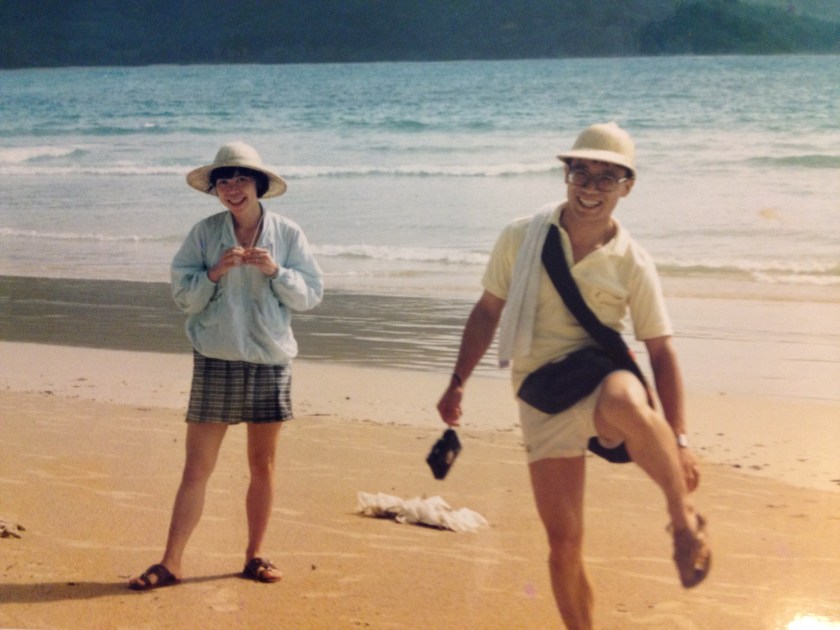
Mom and Dad, circa 1988?

Dear Wilton,

In light of the recent world events, it is a good time to reflect on something more positive as Thanksgiving is here. Perhaps, to you, it is just a prelude to a long winter holiday. I remember those days when I was your age. Thanksgiving, as an American tradition, held no meaning for our family.

However, since coming to the States and having spent several Thanksgivings with my dear friends and their families who hosted me, I learned that it is indeed a good thing to have a day set aside to reflect on the positive.

Every year, every day, every second something can easily go wrong. Sometimes it can go so wrong your life depends on the next move you make. So, it is because of this exact unpredictability and fragility that we should celebrate gratitude.

I will keep it simple today. Let us remember to thank those who came into our lives. Let us reflect on the beauty of the natural world and all the positive things that happened to us this year.

On another note. See you soon!

With Love,

Your Brother

Letters on Tuesdays – Seeing the World

Dear Wilton,

We have been very privileged. Remember to thank mom and dad. Our parents never really stopped us from exploring the world around us, though sometimes it definitely made them uncomfortable. They were not passive either. Indeed, you can recall the numerous times that they took us on vacations to different countries in an effort to broaden our worldview and our horizons.

Travelling and seeing the world take on different meanings as you grow older. As a kid, I was fascinated by the physical differences of all the places we went. Every place looked different and felt different. Some, like Singapore, was hot and humid. Others, like Thailand, was more rural and resort-like. Still others, like Japan, was highly technologically advanced. I was focused, always, on the present moment and present location. Slowly, however, I began to become more interested in the fabric that makes each place unique: history, environment, people, culture, etc.

Perhaps the change was driven by my own interests in history and biology, further developed by my pursuit of an anthropology minor in college and then later, a masters degree in social sciences. There is not a single right way to travel and see the world but, to me, I believe the more holistic a view of a place, the more you learn and enjoy.

Dad used to travel differently, though he falls into his old habits. Every place we went to, he would have a full itinerary. He hustled our family to every possible point of interest in as efficient an amount of time possible. What he didn’t realize is, for us, it made travelling a task instead of something to enjoy. It also made it difficult for your sisters and I to develop strong memories of a place. Most of my memories of our family vacations are faded, recalled only in old photographs. My favorite family travel memories from those days are of the times when your sisters and I got to play around and relax, like playing on the beach in Phuket or crying after Space Mountain in Tokyo.

We definitely changed that. You might recalled the easy way we experienced Yellowstone as a family in 2014, when we really took our time to explore and to learn about the park and its surrounding areas and towns. We biked along a creek and had ice-cream, literally all the time. There were still times when dad was on edge about how little we seemed to be doing, but this style of leisure definitely suited mom, your sisters, and me better.

We are too hard on him. Everyone approaches travel differently. Who knows, maybe you actually prefer dad’s method. To him, travel is like stamp-collecting (one of his hobbies as a kid, if you didn’t know). Dad wants to see as many points of interest as possible and collecting as many sights as he can. That is an admirable endeavor. This type of travel is definitely become more prevalent, with the rise of technology like Yelp, Foursquare, and Instagram. In some ways, checking-in has become the equivalent of dad’s see-everything-as-efficiently-as-possible. Travel becomes itemized into achievements, which can be amazing as it brings you the focus and goal to see the world. Again, different methods.

You know this by now: there is a lot of the world to see. In the end, you have to decide how to see it and that in turns determines the meanings of your travels.

With Love,

Your Brother

Reimagined 3016

The world was wicked. They burned the ground and slowly chocked everyone and cooked everything with pillars of invisible smoke. One day, a tribe decided they must call the rain to wash the air and wash the land, so the rain came and never stopped. The water rose and rose, slowly and steadily ate the earth. At first the water was so foul, everything that touched it died. People tried to run and tried to hide but there was nowhere to go. Water became everything, drowning everywhere. Even the tribe that called the rain vanished under the water. It was many suns before the water went away.

There was a woman. When the rain first came, she took her son to a mighty mountain that was the only place that was to be spared from the water. It was in the East. When they started climbing the mountain, a landslide blocked everyone behind from following them. The woman and her young son found a hidden valley, full of animals who escaped and full of trees, flowers, and plants. Shielded by the mountain, it was untouched by all the smoke and fire and all the rain and water.

The queen of the animals was an old elephant matriarch of great wisdom. She had gathered all the animals she could find and led them to this valley before the rain. The wise elephant welcomed the woman and her son, however, the queen warned them not to climb the walls of the valley lest their human touch break the rocks and flood the valley. The woman was surprised that she could talk to the elephant. With the elephant’s help, the animals soon taught the woman and her son the ways of nature and how to speak all the animal languages so that they can survive in the valley.

Years passed and the son grew into a fine young man. He took the name Nyanm after the language of the elephants. The queen was especially fond of Nyanm. He was stronger than all the animals except bears, smarter than all except elephants, and faster than all except cheetahs. One day, while in a tree hunting for mangoes, he spotted a crack in the side of the valley. He was too young to remember the queen’s warning and being curious, he moved towards the crack. Fascinated and having never seen a cracked rock before, he reached out and traced the crack with his finger.

Suddenly a loud rumble shook the valley and threw Nyanm through the growing crack. The queen immediately knew what happened, and with tears in her eyes, she carried the woman to the cracked rock. A huge hole opened up, showing lightning and rain outside of the valley, while Nyanm laid outside in shock. Before the elephant threw the woman out to her son, she told the woman to take her son North. There they will find land to live on. Then, the walls of the valley come crumbling down, forever closing the valley.

Nyanm and his mother slowly traveled North, suffering the cold and the wet rain for many days until one day, they saw in the distance a land with blue skies and the sun. When they arrived, there was green grass all around them and a clear, blue lake with floating ice like crystal. A small hut stood by the lake. There lived a young woman named Shiwo, the sound of water. She brought them inside, fed them, and gave them clean clothes. Nyanm quickly fell in love with the young woman and they eventually became husband and wife.

Shiwo had magic and she taught Nyanm. She created animals and people, unlike any seen before, out of the lake water and mud. As soon as they come alive, they wander off in all directions, never to been seen again. Shiwo explained that the animals and the people are looking for other lands to settle as the great flood had slowly retreated. Nyanm with his knowledge of animals learned in the valley eventually helped Shiwo to make some animals that stayed. This is how Shiwo and Nyanm became the life-givers. They gave birth to the people and animals that now live here and everywhere, and so the world came to be.

– William Hsu
November 2, 2016

As inspired by the book, African Myths of Origin by Penguin Classics.

Analyzing Density Bonus Developments in the City of Los Angeles

On February 22, 2016, I started the GIS Specialization Course with UC Davis through Coursera. For those of you who have paid attention, I have started the final course of the specialization: Geospatial Analysis Project. As with other Coursera specializations, this is a Capstone project that is the culmination of the previous courses.

For this project, I have to propose, design, analyze, and present a geospatial analysis project from start to finish. This week requires the creation of my project proposal, which is as follows (if any of you have suggestions on data sources and/or analysis, please feel free to comment):

What is Density Bonus?
Density Bonus is a program through which a developer can apply for a project with a unit density greater than that allowed by the current land use zoning, as calculated from unit floor area and floor area ratio (FAR). In exchange for the higher density, the developer must set aside a certain number of units to be affordable: this is by restricting the rent levels or sale prices to targeted income levels based on the Area Median Income (AMI). To facilitate and to lower the costs of these projects, the developer is granted between one to three development reliefs, based on the percentage of affordable set-aside, such as parking requirement reduction and increase in building height.

Background Information
In January 2005, SB 1818 which amended the State of California’s Density Bonus program became effective. This change in policy mandated that local jurisdictions must bring their ordinances into conformance with the State requirements. Until local jurisdictions are able to update their laws, the State policy applies. The City of Los Angeles enacted its version of the Density Bonus program in February, 2008. In other words, from 2005 onwards, Density Bonus has been in effect in Los Angeles. Around 620 projects (based on data up till mid-September) has been recorded and entitled by the Department of City Planning. Furthermore, year-to-year there has been a steady rise in the number of applications which illustrates the growing popularity of this program.

As the U.S. economy continues to recover from the 2008 recession, Los Angeles has been facing a growing housing crisis and greater development pressure. Density Bonus has become a way to fast-track housing development in a city where the zoning is often very restrictive. With the City’s own Density Bonus program nearing a decade of existence, it becomes imperative to understand if these new projects are built where needed and if these projects are in fact contributing to greater housing equality.

This project proposes to 1) locate where Density Bonus projects are being entitled and 2) analyze the demographic and physical conditions behind those applications.

Research Question/Hypothesis and Expected Results
For this project the research question is where are density bonus projects being proposed and what are the underlying demographic and physical conditions of their locations?

Despite the affordability requirements, the expected result is that density bonus projects will likely be located in higher than average income areas with better public amenities, such as transit and parks, as they provide for greater return on investments.

Potential Data Sources
For this project, publicly available data from the City of Los Angeles Department of City Planning (LADCP), the Los Angeles County Metropolitan Transportation Authority (Metro), the LA County GIS Data Portal, and the U.S. Census Bureau.

Entitlement data is typically made available through public requests to the Department of City Planning, while GIS data on city boundaries, transit stops, and parks are freely available through the GIS portals of the LADCP, Metro, and LA County.

Demographic data, available at census tracts and census blocks geography, is freely available through the U.S. Census Bureau.

Overview of Data and Sources:

Entitlements – LADCP
Transit – Metro
Parks – LA County
Demographics – U.S. Census Bureau

Method
The planned method of analysis will require several steps:

  • Intersect demographics data at census block or census tract level to Los Angeles city boundaries. This will result in only those census blocks or tracts that fall within the City.
  • Create buffers around transit stops and parks based on pedestrian sheds, defined as a five-minute walking distance or a quarter-mile.
  • Use overlay analysis with buffers and entitlement locations to evaluate proximity of projects to amenities.
  • Spatial join the entitlements (points) with the demographic data (polygons) to evaluate income levels.

With years available for the entitlement data, this analysis can be performed for every year, starting from 2005, to evaluate changes in development project trends. One of the challenges of this project will be joining the points data and the polygons data to create products with meaningful indicators. In many ways, this project is the reverse of a site suitability study: this is an attempt to deduce the considerations behind density bonus projects.

The Bus (in America)

It’s always darker in here.
There are days without light.
Even those loud colors
are subdued on the upholstery.

Then there are the bangs,
shocks and impacts,
direct hits of the road
rattling up backs and spines.

Rain dampens the floor
with sun baked crumbs,
gums and who knows what
left behind, left forgotten.

The morning swell through the doors
of untold routines and responsibilities.
These weary eyes and ears
time for signs to disembark.

Yes, all is trapped,
on routes dictated by stops.
Outside the window,
single passengers throttle by.

It struggles to navigate
the sea of more nimble cars.
It struggles to maintain
a timely pace.

Waiting could mean five minutes
or twenty, with a near miss.
Sometimes, a short sprint is required.
It doesn’t wait.

A suit and tie is rare
among sweaters and hoodies,
just as an unwashed shirt
always lingers in the corners.

It’s a decisive non-decision,
collectively by those whose
only way to get somewhere,
is trapped together with some bodies.

– Fu Lien Hsu
Oct 27, 2016

Letters on Tuesdays – Until A Basket to Reach Into

Dear Wilton,

Though we are thirteen years apart, as siblings growing up with nearly identical upbringings, we have many similarities. You grew up surrounded by the very books your sisters and I read. Over the years, I have seen you develop a love for reading through them. Like me, you are captivated by books and we have voracious appetites for the written word. I am certain it is because our books give us wings, wings to fly into foreign and imagined lands. The written word can easily become magic in a young mind. The written word relaxes us and takes us places where our worries become thin air and where our fears are replaced by a character’s.

There are untold amounts of joy when I see you engrossed in one of my old novels. I can imagine you going through the same emotions, the same questions, and the same challenges with each book. Though it pains me to see  you having less care for the physical conditions of the books than I, for many were still in near pristine condition since I last touched them. Our mother always questioned if I ever read those books, despite the pages being cut. It is never a question with you. In your hands, their spines become folded, their pages dogeared, their covers battered. I could never foster in you the same care. Perhaps as you grow older, I could.

However, back to the main road of this discussion. As you grow out of the young adult novels and move into the realm of “serious” literature, I look forward to the possibility of discussing themes and plots with you. The older I get, the more fond I am of the time-enduring classics. Despite the impressions some of them might leave in high school, you will find yourself understanding these books very differently later. The slow and gradual filling of your basket of life experiences will nourish and color your understanding. It might even fuel your appreciation for books that left a bad taste.

My hope is that you will be able to maintain your love of reading and your habit of reading until you have a basket of experiences. The need to pursue so-called careers and life goals, more often than not, drains one of any energy or motivation to continue reading. This phenomena is very evident once you enter the workforce. It is unfortunate because reading makes you a more effective and precise communicator of ideas and thoughts; a skill that will actually propel you further in your career. Even more so, it is most unfortunate because it is precisely when you enter the workforce and become truly independent that your basket begins to fill; it is precisely when you begin to better understand the intricacies of the written word.

As I look around at this point in my life, many of my colleagues and peers seldom or no longer read anymore. I can easily empathize. There are days when I am so completely drained, I have no desire to do anything of substance. Yet to that I say, try your darnedest to keep up a reading habit. I try to read at least a book a week and so far I have managed. I firmly believe that this habit has allowed me perspective to digest my own basket of experiences and to use my basket to better understand what I read — life mirrors books; books mirror life.

Finally, I remember that you desire becoming a writer. It is my strong advice that you maintain your reading habit until you have a fuller basket to reach into. If you lose your reading habit, you will never be able to weave your basket full of experiences into your own voice. Remember, a voice is gold for a writer.

With love,

Your Brother

Letters on Tuesdays – Defining Success

Image used cause my friend, pictured above, is a very successful man. I am sure you remember him.

Dear Wilton,

Last week I wrote about failure and accepting failure. In light of the previous discussion, it would make sense to discuss success. Yet, I do not believe we ever talked about how you defined success or what you saw as success. I remember when I was your age, thirteen years ago, I believed that success consisted of a few things: the best grades in class, the most friends, and the most athletic. Some of my friends, if they knew what I thought, would probably laugh at how absurdly unsuccessful I was and, to be honest, I am chuckling to myself right now at how absurd  my definition of success was. Yet, this might very well be how you are seeing success right now: getting that A in class, getting into that boarding school.

You see, like failure with its internal and external components, success can either be defined by you or by people other than you. Many times when we see success, such as having good grades, going to a good school, or having a good job, it is defined by others. For most of our early life, success is defined by others and usually by our parents. There is nothing wrong with that, as there is nothing wrong with defining success with accomplishments. As I found out, these small “successes” create the foundation for me to build a bigger, more lasting, and more personal idea of success. It is important to eventually personally define a lasting success to pursue.

Knowing you, you are probably asking why at this point. The answer is because formulating a personal brand of success will allow you to become happier, more productive, and even more successful. It is very much contingent to finding who you are and what you love to do – which is based on you achieving the small “successes”. In fact, I would equate success to exact that: finding yourself and your passion. By doing so, you will find the foundation of success from which you will find snowballing into a life full of the successes defined by others and by accomplishments.

If you do not develop that personal foundation of success, it is still possible to lead a happy and successful life. Yet, I would dare to venture that it is more unlikely. You become bound and defined by others and their opinions, which is ever-changing. To keep up with changing trends will fatigue you as you constantly reinvent yourself. I am sure you are now old enough to see that. For example, twenty years ago, being successful for our parents might more likely mean becoming a doctor or a professor. Today, our generation might more likely define success as pursuing a career in what you love doing. Tomorrow, who knows what success will mean? Perhaps it is becoming the human ambassador to space-faring alien civilizations.

Which is why, to me, it is important to develop a personal foundation of success after you learn from the success, as defined by others, that you achieve. When you discover and accept who you are, you find yourself more confident. That confidence allows you to grow your abilities and to attract people. You will find that to become successful in life, it depends on your abilities and quality people you are able to connect with. This is why I equate true success to finding who you are and what you love to do. No matter what happens you always have that foundation of success to fall back on. You can always draw on that confidence from knowing who you are and that confidence in your abilities.

With love,

Your Brother

Letters on Tuesdays – Failure is Inevitable

Dear Wilton,

Today, I want to write to you about failure. This is related to the first letter I wrote you two weeks ago, but this time I want to directly tackle your fear of failure. The timing is, perhaps, impeccable as you make your way with our parents to interview at various boarding schools.

You have mentioned how you feared that you are not good enough, that you are going to fail to impress the admissions at the various boarding schools. Well, the truth is, we all face failures throughout our lives. Whether it be failing to convince our parents to buy us that toy when we were a kid, to failing to be accepted by our dream school when we were in high school, to failing to land that “perfect” job when we graduated, or to failing to complete a project to satisfaction when we are worked.

You see, failure comes from having expectations. Expectations are standards of achievements we set for ourselves and sometimes for others. Not that there is anything wrong with having expectations; they provide us standards to strive for. Yet, through this lens almost everything can be defined as a failure. It is when we, or others, fall short of our expectations that we deem something as a failure, because what was achieved was not up to the standards we set. Most of the time, it happens because of things we cannot control.

As with most things in life, nothing is for certain. Sometimes, one minor detail result in failure: that terrible meal you had could give you a physical reaction that renders you temporarily infirm or that argument you had with your project team just before you are about to deliver. This is why failure is inevitable. We live in a world with a constantly changing and mostly imperfect set of conditions. Failure can happen to the best and the most prepared of us and that is completely okay. Hence, what is important is not that we failed, but that we pick ourselves up after.

What we learn as we grow is not that we should lower standards for ourselves, but that we should stop imposing our standards on others and on things out of our control. Not only will this ease the feeling of failure, it will ease your mind about failure. Once you accept the fact that you can only control your own actions and reactions, failure becomes based on what you can do for yourself. When you try your best, you learn something more about yourself and about your abilities and your standards. When you try your best, you meet your own standards. Now, meeting your own standards, that is success. Learning about yourself, that is success.

If you do fail your own standards, learn from what you did wrong. That can be defined as success. Having expectations about how you handle failure is a measure of success. Perhaps you failed to achieved what you set out to do, but the way you handle that failure can actually turn defeat into  victory.

Remember, we will fail at various points in our lives because we are imperfect beings existing in an imperfect world. That is okay, because we can find success even when we fail.

With love,

Your Brother

Unexpectedly

Goes by hand
Hand that used to be sand.

It goes to a dozen numbers
Around.

Watching it
Slowly.

Turning away
Quickly.

Yet
It brings everything.

The one thing
that matters.

To be suddenly caught
Standstill.

Like the wind it knocks
Over.

Or, pull the metaphorical rug
Under.