Author: William Hsu

Customer Service is…

Today, I helped out with the Taiwan Products Day in San Gabriel, CA. It was a great learning experience and one of the first times I helped out with a large scale event. Customer service was incredibly important and I found it amazing to help people. With a winning smile and great patience, it was amazing to see how easy it is to make someone feel comfortable. I enjoyed solving problems as well. One of the vendors could not find her package at all and it was essential for her meetings with her buyers today. (Hooray Google!), after obtaining her tracking number and the logistics company, I was able to track her package. We found that it was delivered safely to the hotel and was misplaced somewhere. With the help of the friendly hotel staff, we were able to locate her parcel and deliver it to her before the event began. It may sound simple, but helping a nervous vendor feel comfortable and ready for her meetings was a great feeling. I began to understand …

If You Want to Visit Peru

As a recent graduate, I have a fair amount of time on my hands while job hunting. This meant that I have plenty of time to indulge in reading, one of my favorite pastimes. I am a pretty avid reader cutting across a variety of subjects: history, biography, biology, classics, philosophy, to name a few. One of my favorites things to read is books about foreign places, cultures, and histories. I recently devoured the book, Turn Right at Machu Picchu: Rediscovering the Lost City One Step at a Time by Mark Adams. The author retraced the expeditions by Hiram Bingham III, who was famous for “discovering” Machu Picchu and a host of other Inca ruins in Peru. The book is highly entertaining and really reminded me of my own time as a research assistant in the Peruvian Amazon. If you are interested in learning a little bit about Inca culture and history, there is lots of nuggets in this book. If you want to visit a foreign place, but is unable to physically at the moment, this book …

Dessert…is the Food for Soul

Let’s take a break from the heavier stuff. In recent years, I have taken quite a liking to cooking and making desserts. This is partly because I am beginning to notice how the food you eat affect how your body functions and feels. Another reason is the sense of accomplishment that comes with making good food. I admit, my skills as a chief is probably only average, but part of the fun is to see my personal growth. With each meal and dessert I make, I gain more experience with how to prepare the ingredients and what to do once the fire is on. Desserts are my favorite things to make. The more challenging the dessert, the more I want to attempt it. I always love a good challenge and a hard dessert is like a puzzle to be solved. Personally, I think unlike main courses and dishes, most dessert recipes require some delicacy to their preparation and cooking. It takes patience and care to make a good dessert. As the ancient Chinese like to …

Who Decides Our Spaces?

In the past week, there were two news items that came to my attention regarding public space. One is in Hong Kong, where the Town Planning Board is reviewing a plan to extend the Avenue of Stars on the Tsim Sha Tsui waterfront. The other is in New York, where the mayor is openly considering the removal of the pedestrian plazas in Time Square. Though the motives and incentives are different, both instances are controversial : they seek to remedy areas that are actually immensely popular (though more for the tourists in the case of Time Square). This brings me to ask, who should be in charge of shaping the urban environments around us? It appears that both in Hong Kong and New York, they appear to employ top-down planning favoring expertise and technical knowledge. Yet, is that really a good approach, especially when most of the decision makers do not necessarily visit or have intimate knowledge of areas they are trying to change. On the other hand, a bottom up approach to planning could …

The Mental Acrobatics of Space

Space has always fascinated me. It is something we experience constantly, but few would pause to give thought about. As a child, I built castles and moats out of rocks and mud. I drew imaginary and fantastic maps. I created cities out of Lego and origami. Yet, I never truly understood the spatial arrangements and relationships between objects. To be honest, despite going to graduate school I still do not completely understand them. In my humble opinion, I believe the interactions between psychology, design, and planning have been quite weak. Why do we prefer smooth edges and straight lines? Why do we have preferences for certain spatial arrangements? Why are certain places more attractive than others, even if they are designed similarly? Why do we prefer to be in the middle of spaces as opposed to the edges? How do we use the space around us and why are some spaces more utilized than others? Certainly, part of the answers to these questions depend on not only personal preferences but also historical and cultural background – …

Data Analysis – Urbanization Effects

The increasing rate of urbanization has been accompanied by a corresponding rise in number of urban studies (Wang, et al., 2011). With most of the world’s population now living in urbanized regions, it becomes fair to ask how does living in cities affect society? Are there differences now that did not exist in previous social arrangements when urban life was the exception and not the norm? Along these lines, I wanted to look at a more fundamental assumption about urbanization – that urbanization drives economic growth, leading to better income levels and standards of living. My first question is simply, does urbanization drive economic growth and improve income levels and standards of living? Alternatively, the question could be asked if urbanization truly drives economic development leading to better living standards or are the roles reversed – does economic development precede urbanization? I will be using the urbanization variables from the Gapminder data set for my code book (e.g. income and urban population). Additionally, if the data proves that urbanization is indeed the driver for better living conditions …

Social Movements and the City: Occupy Central

Social Movements and the City is the culmination of my time at Arizona State University – leading to the completion of my M.A. degree. The Occupy Central movement in Hong Kong greatly interests me because I was raised there. Using a political ecology framework, I examined the historical, cultural, political, and social backdrop to the mass occupation and protest that occurred in the financial center of Hong Kong between September and December 2014. I argued that the protests were responses to issues greater than universal suffrage: Hong Kong’s tensions with China started long before the handover in 1997. However, what interested me the most was the use of physical space and the transformation of the meaning of space. How do urban spaces play in the development of social movements and protests? How did the design of the city affect occupation and the subsequent clashes with law enforcement? How was material and economic flows disrupted or altered? Despite the doomsday prognosis of critics of the blockade, the city’s economy and transportation systems continued to operate, as the …

Smart Growth Planning in Phoenix Project

The Water, Energy, and Infrastructure Co-benefits of Smart Growth Planning in Phoenix, Arizona was a large-scale project under the guidance of Dr. Mikhail Chester. It spanned several disciplines in Arizona State University and compared impacts from traditional planning and development in Arizona with smart growth planning. The project focused the changing needs and economies of areas identified by The Maricopa Association of Government’s Sustainable Transportation and Land Use Integration Study in the urban core. With growing awareness of the increasing costs of roadway maintenance and of climate change, this project is the latest in a series to produce analysis and data to convince policy makers and stakeholders in changing the trajectory of land use and development in the valley. My team’s role primarily focused on the qualitative analysis of political and socio-economic barriers against implementation of integrated land-use planning in the metropolitan area. With the results from each division of the project, we investigated possible changes to the behavioral patterns of residents. We identified issues such as established institutions against cooperation between the various cities in the region, …

Maushaus

The Maushaus project was the brainchild of Sigma Dolins and her interdisciplinary team: Kayce Flowers, Keith Guiley, Will Hsu, and Jared Stoltzfus. This project was our answer to the lack of affordable housing and alternatives to detached singled family housing in the Phoenix Valley. Maushaus was envisioned as a showcase micro-dwelling building to demonstrate green energy and sustainable living habits. With little more than $6000 from different corporate sponsors and a successful Kickstarter with over 60 donors, Maushaus features a compostable toilet, dual paned windows, an Ikea kitchen and a loft with a queen-sized bed. We designed and built it from recycled structural insulated panels (SIP), which allows for increased energy savings from its high insulation rating. Despite summers in Arizona reaching over 110 F, the inside of Maushaus can reach up to 20 degrees cooler, even without air-conditioning. With our research and design, we realized the energy and financial savings such a house can deliver for its owners. Through this experience, we calculate that a brand new Maushaus will cost around $30,000 – incredibly affordable housing, especially if deployed on a mass …

Glendale Historic Downtown Redesign

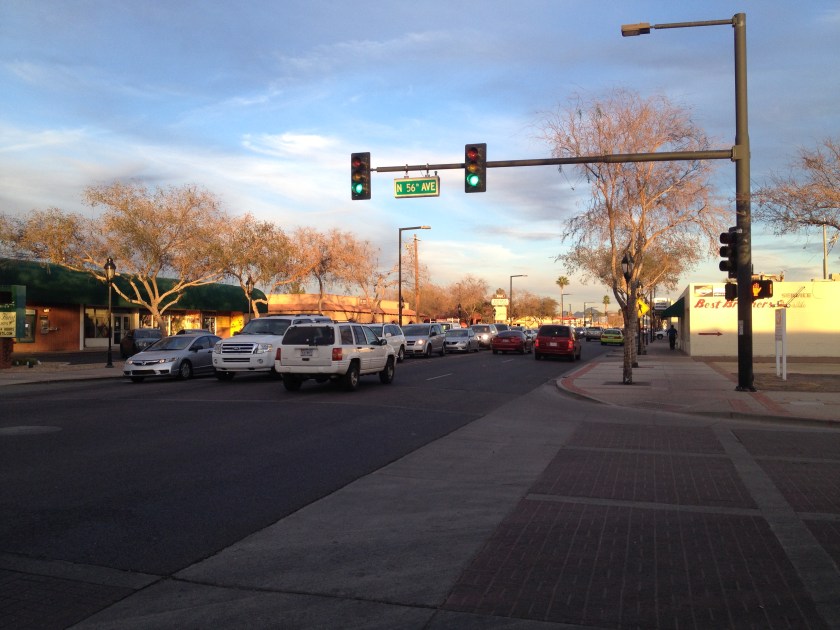
Glendale Historic Downtown Redesign was an urban redevelopment and design project for the city of Glendale, Arizona. With an aging population and a struggling economy, Glendale has been trying to revitalize its downtown core for years (culminating in the hosting of Superbowl XLIX). This project was an attempt to address these issues by developing a plan, through development and policy, that will benefit parts of the historic downtown. Under the guidance of Professor Emily Talen and Dr. Michael Powe, we followed the Preservation Green Lab‘s methodology in examining neighborhood physical characteristics through a combined measure of building age, building diversity, and lot size. Using grid overlay analysis, we incorporated demographic data from the U.S. Census Bureau and identified and presented a neighborhood that had the greatest potential for revitalization through existing policy and design. In addition, we conducted field observations of the study area. Some of the issues we found was the lack of consistent frontage which reduced the physical attractiveness of the area. There was a lack of mix-used buildings, with would serve to bring residents and businesses together. In addition, …